

Ismail Kadare The Writer and the Dictatorship 1957-1990
اضيف الخبر في يوم الجمعة ٠٧ - سبتمبر - ٢٠١٢ ١٢:٠٠ صباحاً.

Ismail Kadare The Writer and the Dictatorship 1957-1990
Being unconvinced by its central thesis, it's only fair to begin by signalling the better side of this Kadarography. Peter Morgan's opening survey of Albanian history from ancient to modern is exemplary in its breadth, depth, and punctilious detail. And, throughout, his literary analyses (up to a point, see below) are the most thorough-going yet attempted in English, from which the reader, Albanologist or general, will learn a lot, as did I.
To my taste, though, Morgan goes overboard in detecting discreet anti-communist sentiments in the smallest of details, a good/bad example being the three pages (133-35) on the supposed multi-symbolism of spectacles in Chronicle in Stone, leading to such bafflegab as: 'If the glasses of the intellectuals give access to the worlds of modernity, the black eye sockets of Kadare's blind seers are the means of access to the underworld of Albanian reality.' To what extent these expiscations are Morgan's own, or provided/invented by Kadare, with whom he is on close terms, is hard to say. For contrast, see Savkar Altinel's review (TLS December 7, 1990), dismissing Chronicle in Stone as 'by and large conventional, without being especially adventurous or innovative,' also tracing an unacknowledged debt to Yugoslave film director Ernir Kusturica's When Father Was Away On Business.
For example, Alan Brownjohn (TLS September 5, 2003), observes that Derek Coltman, who in 1971 Englished Albin Michel's French version, added to his republication 'numerous authorial revisions incorporated in the 1998 French version.' As I have frequenty mentioned in print, in the analogous case of another spurious dissident, Kadare's protégé Neshat Tozaj, his novel Të Thikat (The Knives) was on authorial admission doctored in some sensitive political areas.
Morgan (283-293) is in thrall to Kadare's ultra-patriotic and largely baseless attempt in his Aeschylus, or The Great Loser, to transfer credit from Greece to Albania for the origins of folklore tales concomitant with tragic drama, with the silly conclusion that Aeschylus was the 'great loser' because only seven of his ninety plays have survived. Exactly the same fate befell Sophocles, on this reckoning an equal loser. More to the present point, Robert Elsie, the greatest living authority on Albanian literature and overall admirer of Kadare's work, appends to his review of the Aeschylus (repr. in Studies in Modern Albanian Literature and Culture, 1996, 67-68) examples of how Kadare fiddled with the text of Cavafy's Greek poetry in his 'translations' thereof, respectively adding and subtracting verses to change the meaning. Elsie cannot decide if this is Kadare the nationalist or Kadare under political pressure at work.
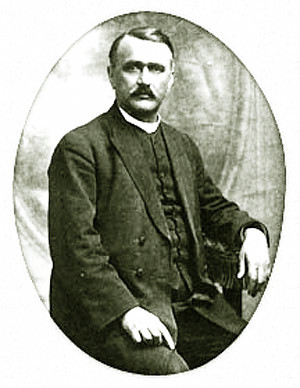
Fr. Bernardin Palaj, O.F.M. (1894-1946), outstanding folklore collector with his colleague Donat Kurti. Palaj was executed by Hoxha's thugs. Ismail Kadare "borrowed" the works of Palaj and Kurti while grossly insulting them.
|
|||||
Likewise, with the anti-Kadare polemics (online) of Janice Rrapi and son Renato, who maintain that Kadare used his influence to have Renato arrested and confined to a mental hospital in order to break up his romance with Kadare's daughter. Family feuds have been endemic to Albania for centuries. Kadare may hint at his own indulgence in suchlike through his absurd laudatory contrasting in the novel Broken April that regulates the traditional murderous vendettas with communism, an attitude in which Morgan tamely acquiesces. It was actually to the credit of the communists that they tried to eliminate these. A vain effort. They remain rampant: an article in the magazine MAPO (June 10, 2010, alluding to a BBC television doumentary of this same year conducted by Philip Alston) estimates that in 2009 at least 90 people were killed in these family feuds, with 1450 (including 800 children) currently immured in the traditional towers of refuge. How can any reasonable person approve this way of life and death?
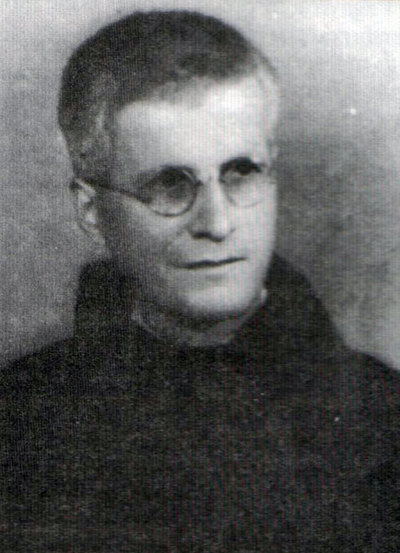
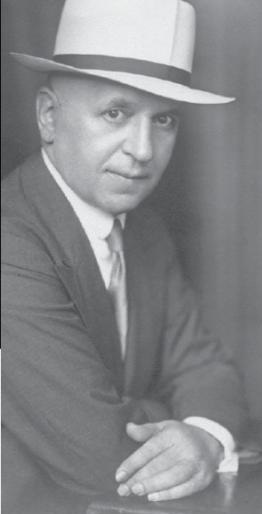
Fr. Donat Kurti, O.F.M. (1902-83), imprisoned from 1946 to 1963 under Hoxha's misrule.
|
A key Albanian text that undermines much of Morgan is the entry for Kadare by the aforementioned Jorgo Bulo in the Party's official Who's Who and What's What, the Fjalori Enciklopedik Shqiptar (Tirana, 1985). It was published after Hoxha's death, hence no question of the dictator's fine protective hand. Kadare could/would have been left out, had he been the suspect dissident we are led to believe.
The entry (complete with large photo) is too long to quote. The opening sentence introduces him as 'Poet and Prose writer, one of the most distinguished figures in Albanian literary socialist realism.' Then, various of his poems are singled out by title, the most lavishly praised one being Përse mendohen këto Male?(What are These Mountains Thinking About?), which hardly tallies with Kadare's claim (reproduce by Morgan, 63) that it was criticised for lack of communist enthusiasm. The novels eulogised are: General of the Dead Army - contra Morgan's claim (82) that it was not well received and caused Kadare's enemies 'to begin to sharpen their knives;' The Castle - a safe historical novel, brimming with patriotism; Chronicle in Stone - despite its supposed (Morgan 138) encoded anti-communism; The Three-Arched Bridge - Morgan's long analysis detects nuanced criticism of Hoxha's message of the constant need for personal sacrifice in the state's interest; Cold Blood (aka The Concert) - an especially striking choice since Morgan (212) claims it was banned until 1988, three years after this official tribute; Dimri i madh (The Great Winter), extolled above all the others for its praise of Hoxha's split with Moscow over Khruschev's denunciation of Stalin - Morgan (156) claims its publication marked the end of Kadare's 'period of protection', which hardly squares with Kadare's own cynical defence of this Hoxha hagiography (quoted by Morgan): ' I never regretted choosing this path. Without it, eighty percent of my work would never have been written.' As I have documented elsewhere, Hoxha (unsurprisingly) praised this novel in public and sanctioned its reprinting.
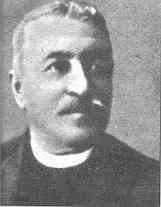
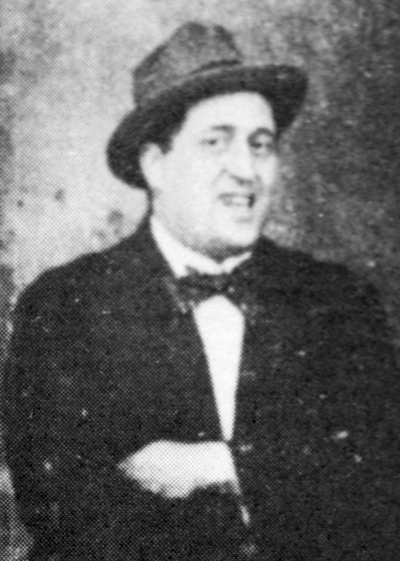
Dom Ndoc Nikaj, S.J. (1865-1951), pioneer of modern Albanian publishing, executed by order of Hoxha, viciously defamed by Ismail Kadare.
|
I also add, as Morgan (228) does not, that two of Kadare's novels, General of the Dead Army and Broken April, despite the supposed bad reception of the former and anti-communist elements in both, were filmed by the state-run AlbStudio, another surprising honour for our suspect dissident.
The other prose work of Kadare here lauded by Bulo is the short story collectionEmblema e Dikurshme (Emblem of that Time), particularly injurious to Morgan's thesis since it contained the opening chapters of The Palace of Dreams, said to be Kadare's boldest and most fiercely persecuted novel - Morgan reluctantly ('admittedly,' 258) records this, significantly (?) leaving it unindexed, adding th"margin-right: 16px; margin-bottom: 5px; float: left; " width="250"> 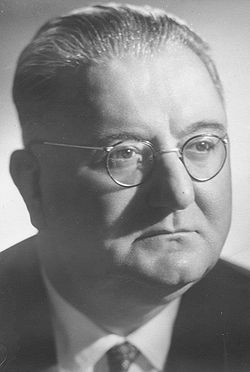
As for Kadare's sudden flight to France on October 25, 1990, why then, at a time when he had been exchanging (on his own admission) in 'constructive' epistolary exchanges with Alia, and when the likes of chief Party ideologist Foto Çami were calling for more open debate and criticism, and only two months before demonstrations and riots signalling the end of communist rule began. He had had plenty of earlier chances. I find it hard to disagree with Renata Dumitrascu (a fugitive from Ceausescu's Romania - see her various 'blogs') that this was the traditional option of rats on a sinking ship: Kadare sensed that the regime under which he had prospered so long was fatally floundering.
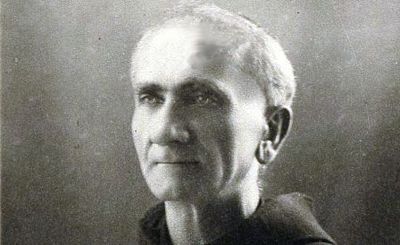
Ernest Koliqi (1901-75), eminent man of letters forced into exile, foully assailed by Ismail Kadare as flattery to Hoxha.
Where was Enver in all this? Morgan frequently states he was from 1980 on increasingly ill (diabetes and Parkinson's) and verging on senile dementia. This doesn't sound as though he was able once again to save Kadare from his literary (more than political) enemies. On the other hand, Morgan does note Hoxha's last public appearance in late 1984, before withdrawing from public life to work on his memoirs. His Titoites (Kadare's rapturous review has already been quoted), with its notorious and much-ridiculed 'unmasking' of Mehmet Shehu as a 'multiple foreign agent' appeared in 1982. I own Albanian videos of him delivering an election address late in the same year and of his 1984 epiphany. In the speech one, he looked and sounded physically and mentally alert. Hard to believe he was the mysterious 'Enver double' described or invented in Lloyd Jones'Biografi (London, 1993).
Kadare is also represented as getting into scalding hot water over his poem The Red Pashas, in 1974. Again at the instigation of Dritëro Agolli, he faced interrogation in the Writers Union offices and went through the motions of self-criticism. No further consequences, save a brief departure from Tirana. The biggest mystery is how the poem physically vanished until its rediscovery in the national archives in 2002 by Maks Velo, who published it (prior to this, some doubted it ever existed – why did Kadare not keep a copy?) and wrote a whole book (cited by Morgan) on the affair. There was nothing politically dangerous in the poem: it satirised bureaucracy, a safe target (Bihiku commends this genre, and it was ubiquitous in the weekly journal Hosteni (The Goad) which I used to read. Kadare took care to insert an entire stanza of gross flattery of Hoxha - Elsie's translation is available online.
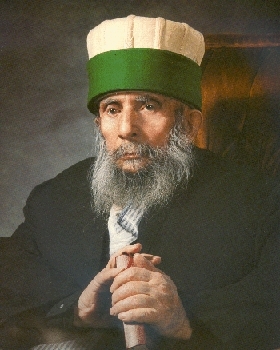
Rahmetli Baba Rexheb Beqiri (1901-95), exiled because of his anti-Communist patriotism, founder of Albanian Bektashism in the U.S. and guardian of its traditions.Fatiha.
|
If, as Morgan maintains, Kadare survived only courtesy of Enver, why did his enemies not 'get' him during the last communist quinquennium? Nexhmije was supposed to have been his deadliest enemy, also the most powerful, widely thought to be pulling the strings of new leader Ramiz Alia. Yet, not only was Kadare unharmed, but promoted by her to Vice-President of the Party's Democratic Front organisation. And, in this period of supposdly enforced literary silence, Kadare published The Concert (1988) and Dossier H (1990), the latter singled out in a survey of commendable new fiction by the Party newspaper Zëri i Popullit (July 27, 1990). He also brought out a collection of short stories Koha e Shkrimeve (Time of the Writers) in 1986, plus his two books on Aeschylus, one receiving a full-page eulogy in ZiP (June 12, 1990) and the multi-language propaganda magazine New Albania (no. 4, 1990. Miranda Vickers and James Pettifer (Albania: From Anarchy to Balkan Identity, London, 1997), generally well-disposed towards Kadare, admit that in 1988 "his innovative novels received official approval." A noisy silence indeed, and a most dulcet dissidence.
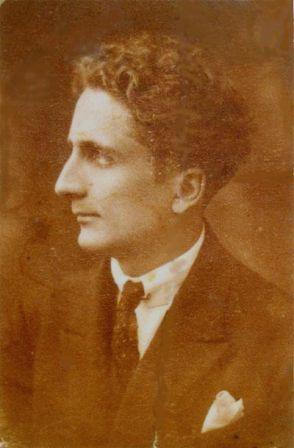
Llazër (Zai) Fundo (1899-1944), poet, comrade of Avni Rustemi (1895-1924), supporter of Imzot Theofan Stilian Noli (1882-1965), anti-Stalinist revolutionary. Brutally murdered by Hoxha's killers in Albania.
|
Elsie remarks that Kadare's return to Albania was met with a 'good deal of indifference.' His Man Booker Prize was greeted wth many protests (and some cheers) published both in Albanian newspapers and on the Man Booker website, aimed at his dissident protestations rather than his literary credentials. For his part, I have read and heard from Elsie and others, that Kadare claims that various Western critics (Elsie, Hans Joachim Hoppe, Noel Malcolm, Stephen Schwartz) are in a conspiracy to deny him the Nobel Prize. As seen, he faces equally deep and quite open hostility from Albanian writers (Lubonja, Myftiu, Rasuli, Trebeshina), genuine dissidents and genuine sufferers. I myself belong to no conspiracy, here only concerned with presenting the documented case against Kadare and arguing that Morgan's failure to face these opposing facts and individuals fatally undermines his eulogy.
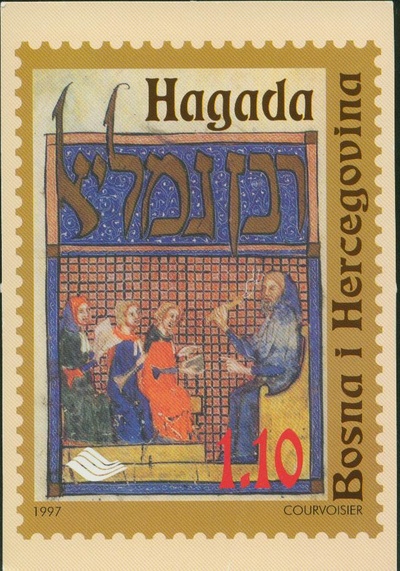
Postage stamp issued by the Republic of Bosnia-Hercegovina honoring theSarajevo Haggadah. Ismail Kadare denounced the Jewish Torah, the Gospels and Qur'an with equal vulgarity, See bold citations in paragraph 8 above.
|
اجمالي القراءات
2055
أضف تعليق
لا بد من تسجيل الدخول اولا قبل التعليق
ÇÎÑ ÇáÇÎÈÇÑ
more
اخبار متعلقة

دعوة للتبرع
مقالات من الارشيف
more



القبر الرجسى : عثرت على صور قديمة لقبر النبى ، وهى في هذا...
تغيظ النار: في سورة الفرق ان الايه 12 ( اذارا تهم من مكان...
الصيام من تانى!!: سلام علی ;ک یا استاذ ناالک ریÙ …. ...
اللسان العربى: العرب معظمه م يرون أن آلله اعزاه م ...
إختلافات القرآنيين: لقد تفرق القرا نيون الي طرائق قددا واراء...
moreالرئيسية | عن الموقع | التيار القراني | القرانبحث | الاتصال| اساسيات اهل القران
 Copyrights (c) 2006 MAH
 جميع الحقوق محفوظة(amir@ahl-alquran.com)