

The Pathway to Peace Begins With President Obama
اضيف الخبر في يوم الإثنين ٢٦ - نوفمبر - ٢٠١٢ ١٢:٠٠ صباحاً.


The Pathway to Peace Begins With President Obama
|

EVENT DETAILS
| DATE | Monday, November 26, 2012 |
| TIME | 1:00 to 3:00 p.m. |
| LOCATION | Carnegie Endowment for International Peace |
| SPEAKERS | Marwan Muasher, Aaron David Miller, William Quandt |
| MODERATOR | Daniel C. Kurtzer |
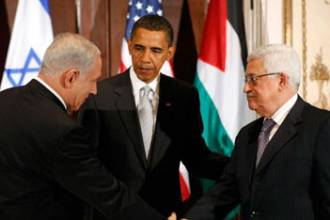
What used to be the measuring stick for a president’s foreign policy legacy—bringing Palestinians and Israeli leaders together to negotiate a lasting peace—has in recent years been largely ignored, overshadowed by the imposing threat of a nuclear Iran and for the first time rarely garnering a mention on the presidential campaign trail.
|

It is clear that leaders in the region will not take the initiative to restart a serious peace process. President Obama should therefore focus the resources available to him to actively reengage in efforts to broker peace in the Middle East through a two-state solution that allows Israelis and Palestinians to live side by side in peace and security.Join the Carnegie Endowment for International Peace for a discussion with former U.S. ambassador to Israel Daniel Kurtzer, vice president for studies at the Carnegie Endowment and former Jordanian deputy prime minister and foreign minister Marwan Muasher, former National Security Council official William Quandt, and former U.S. peace negotiator Aaron David Miller. The forum will take a close look at Pathways to Peace: America and the Arab-Israeli Conflict, a collection of policy essays edited by Ambassador Kurtzer that brings together the world’s leading practitioners and scholars to counter the status quo and make a serious effort to advance Palestinian-Israeli peace. The book argues that a pathway to peace is within reach and that sustained American leadership is what is needed to help “regional leaders ">William Quandt holds the Edward R. Stettinius chair at the department of politics at the University of Virginia. Prior to this appointment, he was a senior fellow in the Foreign Policy Studies Program at the Brookings Institution, where he conducted research on the Middle East, American policy toward the Arab-Israeli conflict, and energy policy. Before going to Brookings in 1979, Quandt served as a staff member on the National Security Council (1972-1974, 1977-1979). He was actively involved in the negotiations that led to the Camp David Accords and the Egyptian-Israeli Peace Treaty.
Moderator
Daniel C. Kurtzer retired in 2005, following a 29-year career in the U.S. Foreign Service, with the rank of career-minister. He served as the U.S. ambassador to Israel (2001-2005) and as the U.S. ambassador to Egypt (1997-2001). He served as a political officer at the American embassies in Cairo and Tel Aviv, deputy director of the Office of Egyptian Affairs, speechwriter on the Policy Planning staff, deputy assistant secretary of state for Near Eastern Affairs, and principal deputy assistant secretary of state for Intelligence and Research. Throughout his career, Kurtzer was instrumental in formulating and executing U.S. policy toward the Middle East peace process. He crafted the 1988 peace initiative of Secretary of State George P. Shultz, and in 1991 served as a member of the U.S. peace team that brought about the Madrid Peace Conference.
 |
|
Carnegie Resources
|
|


|
About the Carnegie Middle East Program
The Carnegie Middle East Program combines in-depth local knowledge with incisive comparative analysis to examine economic, socio-political, and strategic interests in the Arab world. Through detailed country studies and the exploration of key cross-cutting themes, the Carnegie Middle East Program, in coordination with the Carnegie Middle East Center, provides analysis and recommendations in both English and Arabic that are deeply informed by knowledge and views from the region. The Carnegie Middle East Program has special expertise in political reform and Islamist participation in pluralistic politics throughout the region. The program produces Sada, a site dedicated to regular analysis of political reform in the Middle East.
About the Carnegie Endowment for International Peace
The Carnegie Endowment for International Peace is a private, nonprofit organization dedicated to advancing cooperation between nations and promoting active international engagement by the United States. Founded in 1910, its work is nonpartisan and dedicated to achieving practical results.
Carnegie is pioneering the first global think tank, with offices now in Washington, Moscow, Beijing,Beirut, and Brussels. These five locations include the centers of world governance and the places whose political evolution and international policies will most determine the near-term possibilities for international peace and economic advance. |
اجمالي القراءات
530
أضف تعليق
لا بد من تسجيل الدخول اولا قبل التعليق
ÇÎÑ ÇáÇÎÈÇÑ
more

اخبار متعلقة
دعوة للتبرع
مقالات من الارشيف
more




تحريفاتهم هى السبب: السلا م عليكم ورحمة الله وبركا ته اريد ان...
أسئلة متعددة: عزيزي الدكت ور أحمد، السلا م عليكم و رحمة...
تحريم الخنزير: لماذا يحرم علينا لحم الخنز ير ؟ ...
قتل ثلث الرعية.: في مقالك \"ديمق راطية الإسل ام\" كتبت عن...
التعـــزيـــــــــر: أعرف أن التعز ير عقوبة اسلام ية أقل من...
moreالرئيسية | عن الموقع | التيار القراني | القرانبحث | الاتصال| اساسيات اهل القران
 Copyrights (c) 2006 MAH
 جميع الحقوق محفوظة(amir@ahl-alquran.com)