

Factors behind the triumph of Islamists in Egypt
اضيف الخبر في يوم الإثنين ١٦ - يناير - ٢٠١٢ ١٢:٠٠ صباحاً.

Factors behind the triumph of Islamists in Egypt
By Tawfik Hamid
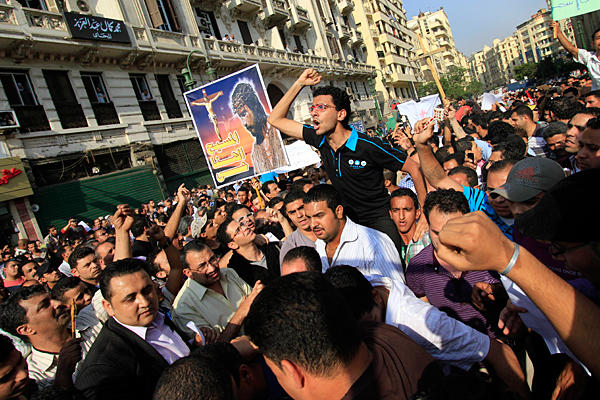
The overwhelming victory for Islamists parties in the first stage of recent and ongoing elections in Egypt deserves critical attention. Careful analysis of the situation in Egypt can reveal that the selection of Islamist parties was due to several reasons. These include:
1- Desire to implement Sharia Rules in the country. Several poll results have shown that a significant number of Egyptians want to implement Sharia Rules within the country. The overwhelming percentage of women who wear the Hijab (Islamic head scarf) and the Niquab (face cover) in the last few decades is a clear indication of the increasing religiosity among the population. In fact, some estimates identify around 80%of women currently wear the Hijab. This percentage by itself correlates well with the percentage of votes gained by Islamist groups in the current elections (around 70%). The desire to implement Sharia Law is partially based on the slogan of the Muslim Brotherhood (MB) that "Islam is the Solution" which gives hope for many Muslims that implementing Sharia Law will magically solve all the problems in the country (Note: Failure of the MB, in Egypt, to fix the economic problems of the country can be the biggest blow to Political Islam in its history).
2- Desire to have less corruption.Several Egyptians supported the Muslim Brotherhood MB with the hope that they will be less corrupt than the Mubarak regime. During my recent visit to Egypt, after the revolution, several Non-religious Egyptians expressed their desire to elect members of the MB for one reason, which was that they are "not corrupt".
(Note: Many Egyptians correlate being more religious with being less corrupt).
3- The Penalty of 500 Egyptian Pounds for not participating in the elections.Several Egyptians expressed on the mainstream TV stations that they only want to do the elections to avoid paying a fine the 500 pounds if they did not participate. Those who participated in the elections only for this reason were simple people and an easy target to be persuaded into voting for the well-organized Islamist groups who uses the word "Islam" effectively to manipulate their simple mind.
4- Feeling of guilt for not being a 'good Muslim'. When I was in the Medical School of Cairo (1978-1984) the Jammaa Islameia (The Islamic Group) used to win the elections of the student unions. Several Muslim students who were not religious at all used to elect the members of Jamma Islameia only because these students felt guilty for not doing the religious edicts of Islam (such as the daily 5 prayers) so -in their view -choosing an Islamic Group was the only good deed they could do for Islam to compensate for not being pious Muslims.
5- "Let us try something new." Several Egyptians expressed their choice for Islamist parties by saying "Let us try something new." In their view, Egypt has tried the socialism (with Nasser), Capitalism (with Sadat), and free market (with Mubarak) and ALL have 'failed'. Accordingly, trying a new experiment with an Islamic system may -as they see it- succeed and thus bring prosperity to the country. This is just like someone who lived in pain for years, who has not been relieved by any medication, becoming a part of a clinical trial to test new medication that may relieve his pains. The attempt of trying something new in this case is based on the "failure" of the other measures rather than a genuine desire and confidence in the new medication. Failure of the SCAF to fix the current economic problems and security concerns of the population have aggravated the desire to try something that has nothing to do with former Mubarak system (i.e. to not be secular and not be military) as these features were linked in their minds to nothing but failure. This feeling made many people place more trust in the Islamic parties as they -unlike secular parties - fit in both criteria of being non-secular and non-Military.
6- Increase in crime rates. Several Egyptians live in fear because of the increasing crime rates after the Jan 25 revolution. Many of those Egyptians feel that the tough criminal Laws of Sharia can help control the streets and bring back security to the Egyptian streets. The support of Islamic parties in this case is based on the desire to have more security in the country and a belief that the criminals who kidnap children and rape women can be deterred only by the tough Sharia criminal laws rather than the 'soft' punishments of western based criminal laws.
7- Lack of trust in current leadership.Failure to put Mubarak and his wife in prison and their "five-star" treatment by the authorities was perceived by many Egyptians as that the Military are still more loyal to Mubarak than to the population. This five-star treatment included destruction of the CD that recorded the communication between the president and his top officials during the revolution. This CD was considered the ONLY evidence that could prove that Mubarak was the one who ordered the killing of the demonstrators. The feeling that the authorities are still pro-Mubarak made many of people desire to have an Islamic system that is - in their opinion - more likely to punish Mubarak, who -as they see him-"stole their money, allowed very high levels of corruption, and killed hundreds of the demonstrators in the Jan 25 revolution".
8- Ignorance. Many ignorant people expressed on Egyptian TV (Al-Quaheera Al-Youm 8/12/2011) that they choose the symbol of the "Balance" (which represents the political party of Muslim Brotherhood). When they were asked why they choose it, many stated that they were told to. When they were asked if they knew what party this symbol represented, many answered that they did not know. The Islamist groups, who are much more organized than secular groups, utilized the ignorance of these individuals effectively.
9- Unclean tactics of some Islamic Parties.
These tactics included:
Ø Bribing the voters with food and occasionally money. This approach was believed to be used more by the Islamic parties as they have more money than their competing secular parties and are well supported by Islamists from different parts of the world.
Ø Defaming secularism.Islamists tried to defame secularism in several ways such as calling it "against Islam" and by promoting that it will encourage nudity and prostitution. This approach worked well with the minds of many Egyptians.
Ø Breaking the laws of the election by promoting their Islamic parties during the 48 hours that preceded the Election Day.
Ø Illegally using the Mosquesand Islam to promote their political parties, knowing that Muslims have a psychological difficulty in rejecting the 'Islamic' option.
10- Failure to understand the consequences of implementing Sharia Laws. Several Egyptians believe that implementing Sharia Laws will bring "blessings' and prosperity to the country. The liberal media were not very effective in making Egyptians realize that implementing Sharia Laws is likely to cause a collapse of the Egyptian tourism industry and will directly affect their own pockets. Failure to understand the negative consequences of implementing the Sharia Laws made many Egyptians more likely to choose Islamic parties as they could not see the negative impact of this choice in their life.
11- Fear of Punishment by Allah for not choosing 'Islam'. Many Egyptian Muslims feel that Allah will punish them if they do not choose an 'Islamic' party, as Allah will see this as rejection of his religion. The fear mechanism works well in the mind of many Egyptians and paralyses their ability to choose any option other than 'Islam'.
12- Weakness of the secular and liberal parties.
These weaknesses can be exemplified by the following points:
Ø Weaker financial resources compared to Islamist parties.
Ø Talking to people from the media without real existence on the Egyptian streets (unlike the Islamists parties that worked hard on the Egyptian streets for the last few decades to provide food and health services for the poor).
Ø Failure to use Islamic text properly to support their secular approach (Note; recently several thinkers such as Ammar Ali Hasan, Bilal Fadl and others have tried to provide an Islamic base to support secularism, but their attempt was relatively too late).
Ø Inability to effectively defame the Islamists. In fact after the January 25, 2011 Revolution, several liberal media offered Radical Islamists air time to speak on mainstream media in a way that actually gave them legitimacy and more respect in the society. This attitude worked against the liberals in the end.
اجمالي القراءات
629
أضف تعليق
لا بد من تسجيل الدخول اولا قبل التعليق
ÇÎÑ ÇáÇÎÈÇÑ
more

اخبار متعلقة
دعوة للتبرع
مقالات من الارشيف
more



Our plans : - What are your plans for the near future?...
عتوا عتوا : هل ( عتو ) من العته ) أي التخل ف العقل ى ؟ لأن ( عتو...
دلالات القرآن الكريم: مرحبا دكتور یاحب ذا أن تكتب مقالا ً عن...
هولاكو وجنكيزخان: قرات مقالة طرفكم عن جنكيز خان. وبقدر مافيه ا ...
لبس بمعنى خلط : ما معنى ( لبس ) في قوله تعالى ( ( الَّذ ِينَ ...
moreالرئيسية | عن الموقع | التيار القراني | القرانبحث | الاتصال| اساسيات اهل القران
 Copyrights (c) 2006 MAH
 جميع الحقوق محفوظة(amir@ahl-alquran.com)